 sql_thegoals360_
Swap Deal Branded the Most One-Sided Transfer in Football History as European Heavyweights Accused of Taking Advantage of Celtic, With Star Warning He Would Cancel His Contract Unless Given the Green Light to Join Bayern Munich
There are transfer sagas, and then there are moments that cut so deeply into a club’s identity that they linger long after the paperwork is signed. Celtic’s latest confrontation with European power has become one of those moments — a deal so controversial that supporters, former players and industry insiders have openly questioned whether Scottish football is ever allowed to negotiate on equal terms when the continent’s elite come calling.
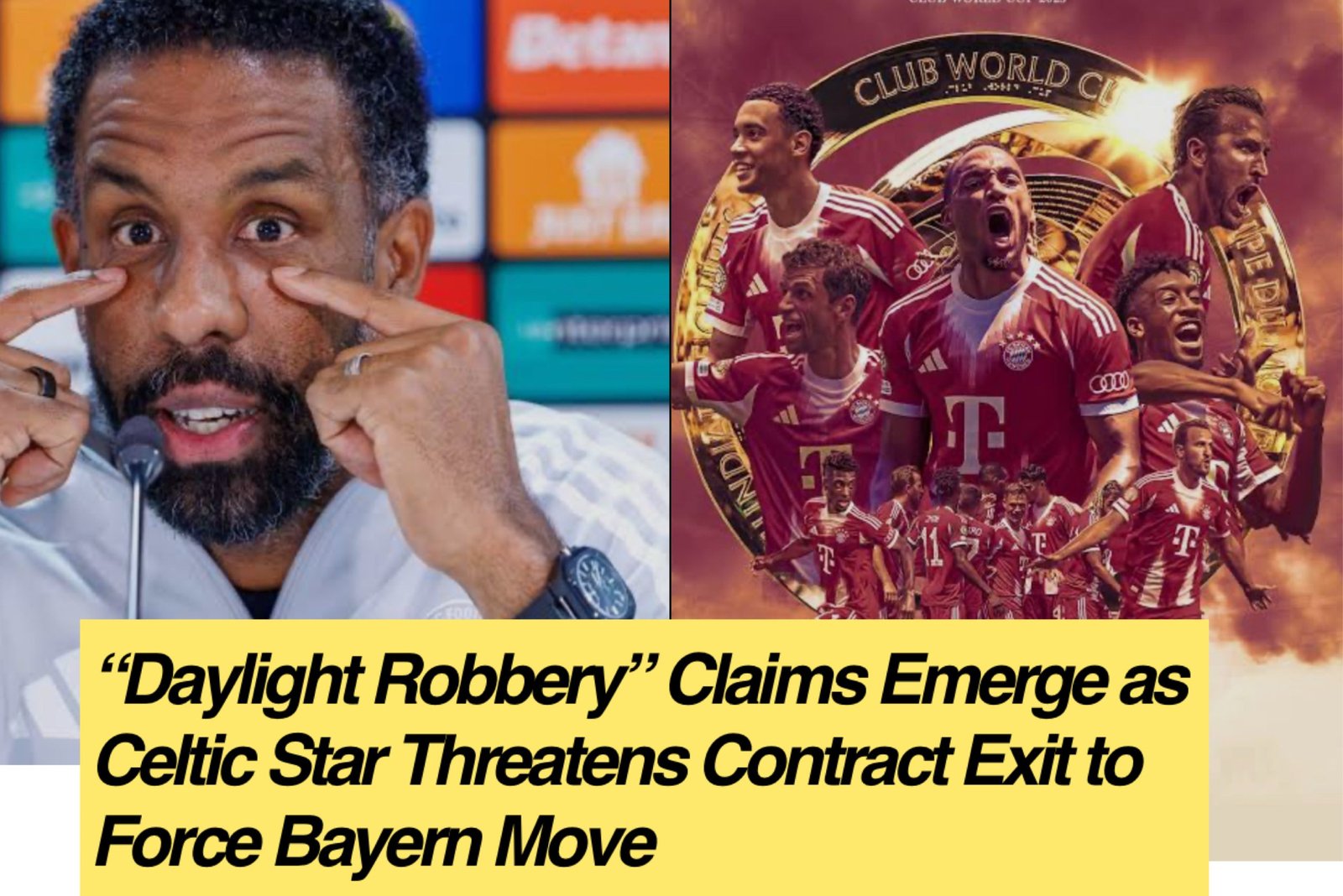
What began as routine interest from Bayern Munich has escalated into a standoff that has shaken Celtic Park to its foundations. A proposed swap arrangement — described by sources close to the negotiations as “laughably unbalanced” — has been condemned in some quarters as the biggest robbery the modern transfer market has seen. At the heart of it all stands one of Celtic’s most important players, a figure whose performances have carried the side through domestic battles and into Europe, now reportedly prepared to terminate his contract outright if the club refuses to sanction his move to Bavaria.
This is not merely about money, or about one player chasing the promise of silverware. It is about power, pressure and the uncomfortable reality facing clubs outside Europe’s wealthiest leagues. Celtic, proud, historic and fiercely supported, have once again found themselves staring into the jaws of a system that rewards financial dominance and punishes resistance.
Bayern’s Interest Becomes Unavoidable
Bayern Munich’s admiration for the Celtic star has been no secret within recruitment circles. Scouts have been regular visitors to Parkhead for more than a year, filing glowing reports about a player whose blend of technical intelligence, physical resilience and tactical maturity has marked him out as someone capable of stepping up to the elite level.
Initially, Celtic were relaxed. Interest from top clubs has become an occupational hazard for successful Scottish sides, and there was confidence that either the player would remain for another season or the club would command a fee that reflected his importance. Contract talks had been ongoing, progress appeared steady, and public messaging from the club suggested calm.
That sense of control evaporated once Bayern formally entered discussions.
Unlike speculative enquiries, Bayern’s approach was decisive. The German champions were not merely monitoring the situation; they were moving with intent. Conversations quickly progressed beyond valuation into structure, and it was here that tensions first surfaced. Rather than presenting a straightforward cash offer, Bayern proposed a complex swap arrangement involving fringe players and performance-related add-ons — a package that Celtic insiders privately dismissed as disrespectful.
To Celtic, the numbers simply did not add up. The player they were being asked to part with was central to their sporting project, while the names being floated in return were either unproven at the highest level or surplus to requirements in Munich. What Bayern framed as “creative structuring” was seen in Glasgow as an attempt to exploit financial disparity.
The Player’s Ultimatum
While Celtic weighed their response, events took a dramatic turn behind the scenes. The player, whose ambition has never been hidden, made it clear to club officials that Bayern represented a once-in-a-lifetime opportunity. He had grown up watching Champions League nights, idolising players who wore the red of Munich, and believed the move was the natural next step in his career.
According to sources, his camp communicated a stark message: block the transfer, and he would explore every legal avenue available to force an exit — including terminating his contract. While such measures are rare and legally complex, the very threat underscored how far relations had deteriorated.
For Celtic, this was a nightmare scenario. Losing a key asset for anything less than full value is damaging; losing him on unfavourable terms due to contractual breakdown would be catastrophic. Yet acquiescing to Bayern’s demands risked setting a precedent that the club could be bullied into submission by richer opponents.
The player’s stance also divided opinion among supporters. Some sympathised with his ambition, recognising that opportunities to join clubs of Bayern’s stature do not come around often. Others felt betrayed, arguing that loyalty should count for something after years of backing from the stands.
A Deal Described as “Daylight Robbery”
As details of the proposed swap began to circulate, reaction was swift and furious. Former players, pundits and analysts did not hold back. One ex-Celtic defender labelled the proposal “daylight robbery,” questioning how a club of Celtic’s standing could even entertain such terms.
The phrase that gained the most traction, however, was “the biggest robbery in football history.” It was dramatic, perhaps hyperbolic, but it captured the mood. Comparisons were drawn to infamous deals of the past, where smaller leagues lost star assets for fractions of their true worth, only to watch them flourish elsewhere.
At the core of the criticism was the imbalance of leverage. Bayern, armed with financial muscle and global prestige, could afford to wait. Celtic, constrained by budget realities and the risk of dressing-room unrest, faced ticking clocks on multiple fronts.
This was not just a negotiation; it was a test of will.
Celtic’s Board Under Fire
Inside Celtic Park, the pressure on the board intensified by the day. Supporters demanded clarity, transparency and resolve. Social media brimmed with anger, with many accusing Bayern of predatory behaviour and questioning UEFA’s role in allowing such disparities to widen unchecked.
Privately, the board were wrestling with competing responsibilities. Protect the club’s long-term interests, or respect a player’s wishes and avoid the fallout of a protracted dispute. Neither option came without risk.
Some within the club argued that standing firm was essential, even if it meant losing the player later on more favourable terms. Others warned that an unhappy, unsettled star could undermine performances on the pitch and destabilise the squad.
What complicated matters further was the broader context. Celtic have worked hard to position themselves as a selling club that operates with professionalism and fairness. If they appeared obstructive, would future talents think twice before committing their prime years to the club?
Bayern’s Calculated Confidence
From Bayern’s perspective, the situation was handled with typical composure. Publicly, they maintained respect for Celtic and praised the player’s qualities. Privately, they were confident that time was on their side.
Bayern’s recruitment strategy has long involved identifying elite talent early and securing it without overpaying. They are adept at exploiting contractual leverage, and they understood that Celtic’s negotiating position weakened with every public sign of unrest.
There was also a sense in Munich that Celtic, despite their stature domestically, ultimately occupy a market tier below Europe’s superclubs. The assumption — controversial though it may be — was that resistance would eventually crumble.
Whether this confidence bordered on arrogance is a matter of interpretation. What is clear is that Bayern never felt compelled to significantly improve their offer.
The Wider Implications for Scottish Football
Beyond the immediate drama, the saga has reignited debate about the place of Scottish clubs in the modern game. While Celtic and Rangers boast rich histories and passionate fanbases, the financial gulf separating them from Europe’s elite grows wider each year.
Television revenue, sponsorship deals and commercial reach all tilt heavily in favour of the top five leagues. As a result, Scottish clubs are often forced into difficult choices: cash in early, or risk losing players for reduced returns.
This case, critics argue, exemplifies that imbalance in its starkest form. When a player feels empowered to threaten contract termination to engineer a move, it suggests a system skewed heavily towards individual and elite-club interests.
There are also concerns about precedent. If Bayern succeed in securing the player on favourable terms, what message does that send to other giants circling talent in smaller leagues?
Dressing Room Fallout
While boardrooms and agents exchanged legal arguments, the impact filtered down to the training pitch. Teammates were aware of the tension, and staff faced the challenge of keeping focus amid uncertainty.
Those close to the squad describe a player torn between gratitude and ambition. He continued to train professionally, but the weight of expectation — and scrutiny — was evident. Every touch, every reaction, was dissected by fans searching for clues.
Managers often speak of “noise” outside the camp. In this case, the noise was deafening.
Fans Caught in the Middle
Perhaps the most poignant aspect of the saga has been the supporters’ dilemma. Celtic fans are fiercely protective of their club, yet many also take pride in seeing their players succeed on the biggest stages.
Banners unfurled in the stands reflected this split. Some urged the player to stay and fight, others wished him well but demanded fair compensation. What united them was anger at what they perceived as Bayern’s attempt to strong-arm their club.
There was also a sense of fatigue — a weariness born of seeing history repeat itself. Talented players arrive, shine, and are eventually lured away by wealth and prestige Celtic cannot match.
Negotiations Reach Breaking Point
As deadlines approached, talks intensified. Lawyers became more prominent, clauses were scrutinised, and the threat of arbitration loomed. Celtic explored alternative buyers, hoping to generate leverage, but the player’s preference for Bayern limited their options.
The German club, meanwhile, held their line.
Insiders suggest that multiple compromise proposals were floated, including improved add-ons and future sell-on clauses. Whether these were genuine concessions or tactical gestures remains disputed.
What is certain is that the atmosphere became increasingly strained. Trust eroded. Communication frayed.
A Defining Moment for Celtic
Regardless of the eventual outcome, this episode will be remembered as a defining moment in Celtic’s modern history. It has exposed vulnerabilities, tested leadership and forced uncomfortable questions about ambition and realism.
If the deal goes through as initially structured, critics will argue that Celtic were outmanoeuvred, victims of a system designed to favour the powerful. If they hold firm and risk losing the player on less favourable terms later, questions will be asked about foresight and flexibility.
There are no easy answers.
The Human Cost
Amid the rhetoric and financial analysis, it is easy to forget the human element. Careers are short. Opportunities fleeting. The player at the centre of this storm faces the pressure of a lifetime decision, weighed against loyalty, legacy and personal ambition.
For Celtic supporters, the pain lies not just in potentially losing a star, but in the manner of it — under duress, with dignity seemingly compromised.
An Uncomfortable Truth
Ultimately, this saga shines a harsh light on an uncomfortable truth about modern football. Romance, loyalty and tradition still matter, but they operate within a framework dominated by wealth and power.
When European giants come calling, resistance requires unity, leverage and, sometimes, a willingness to walk away. Whether Celtic possess all three in this instance remains to be seen.
What is beyond doubt is that this proposed swap deal has already left scars. Labeled the biggest robbery in football history by its fiercest critics, it stands as a cautionary tale — one that will be cited whenever smaller leagues confront the might of the game’s elite.
As the dust settles, Celtic will move on, as they always have. But the questions raised by this episode will linger, echoing through boardrooms and terraces alike, long after the transfer window closes.

 sql_thegoals360_